The Centaur Gap
The question is no longer whether AI will replace humans at the workplace, but who will survive the transition and what kind of society will be left afterwards.
The current consensus is that humans still retain a clear advantage over the AI algorithms in three areas.
First, real and meaningful creativity and the ability to come up with ideas that are truly original. Machines are great at recombining old patterns, but humans can step back, completely reframe the problem, and actually change reality.
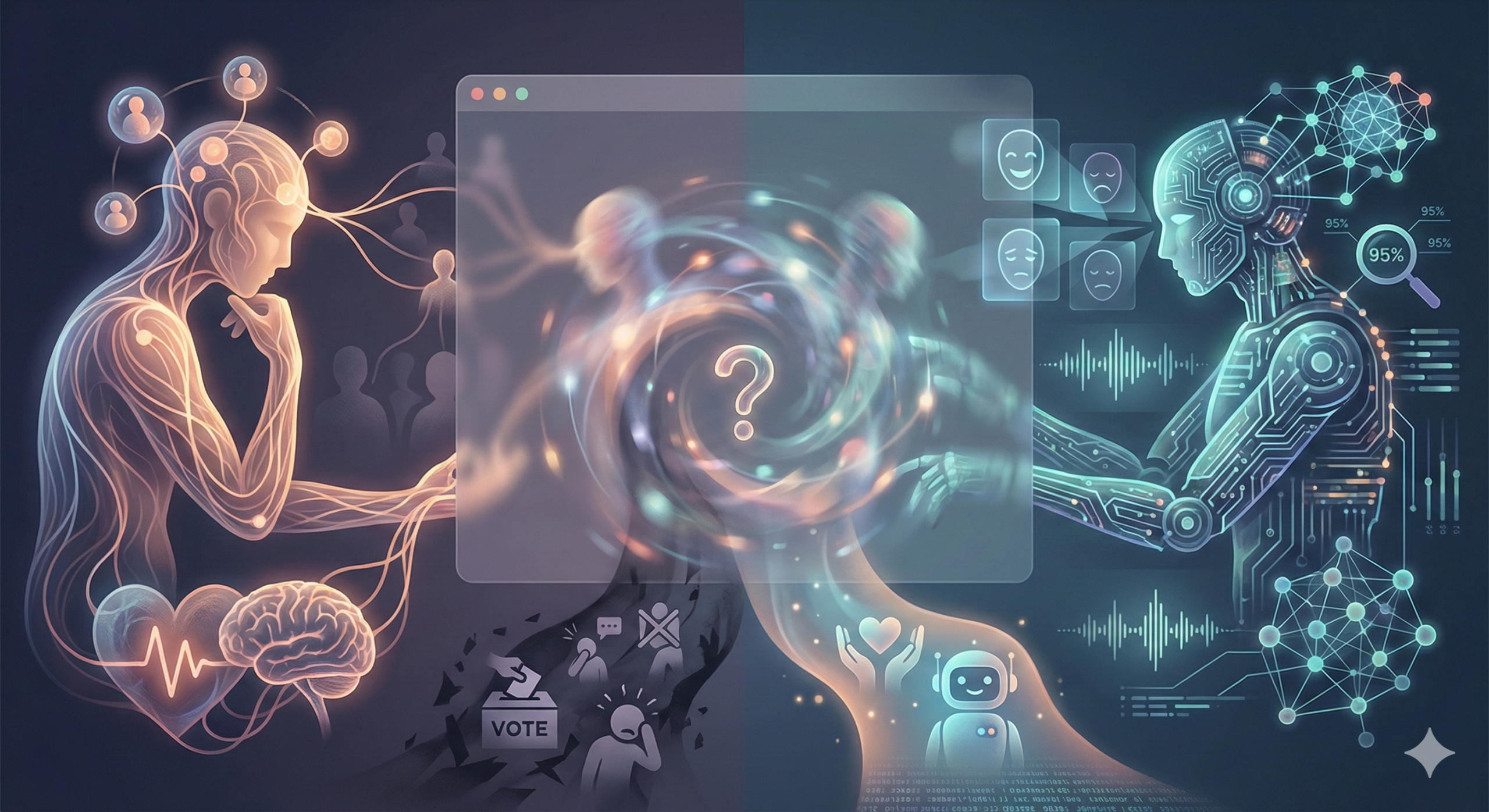
Second, the ability to handle complex social situations and read the subtle nuances of culture and society. This comes from lived, physical experience in the world, where everyone grew up inside a specific time and culture, and from what neuroscientist Antonio Damasio called somatic markers, the gut feelings that guide us rather than language alone (Damasio, 1994).
Third, the rich, context-sensitive way humans perceive the world and construct meaning from it.
These three human capacities are the real bottleneck to full AI automation.
Nevertheless, some jobs will be lost in this revolution. Routine intellectual work like repetitive tasks, pattern recognition in data, pulling information together, is already disappearing. But roles that truly demand creativity, social intelligence, and human judgment are far harder to automate (Frey and Osborne, 2017).
What follows from this logic is that knowledge workers must not ignore AI. They must learn to use it and work with it. This is where centaurs come in.
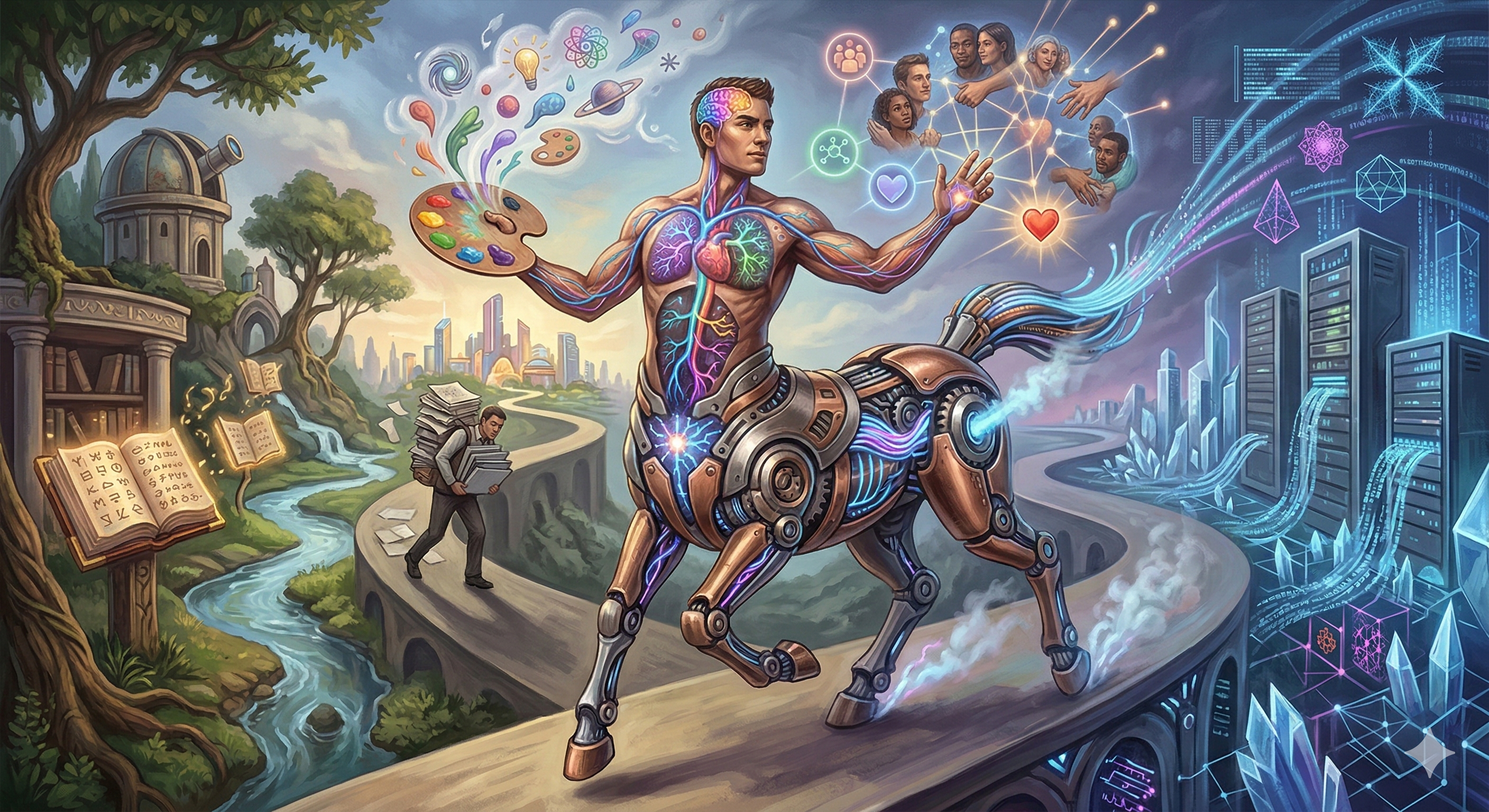
The centaur, from Greek mythology, was half-horse, half-man, a fusion of the two. The centaur worker of the future is not someone who delegates to AI and supervises the output. They are someone who integrates AI into their own cognitive workflow, using algorithmic speed and power to extend their human capacities. The fusion is the point. Neither half is dispensable.
Take psychology for example. A psychologist is likely not going to be replaced by AI. The relationship with a patient, the capacity to read between the lines, to interpret non-verbal communication, to adapt to a particular individual, these are precisely the social and perceptual capacities that cannot be automated.
But parts of what a psychologist does, literature review, assessment scoring, pattern identification in research data, statistical data analysis, progress tracking, these can benefit from AI augmentation. The psychologist who learns to use AI effectively will be more productive and better at their job. Psychologists who refuse to engage with the technology will find themselves outpaced, not by AI, but by their AI-augmented peers (Dell’Acqua, et al., 2023. The competitive displacement is human-to-human, not machine-to-human.
However, there are limits to this purely technological point of view of the centaur model. It only works for a specific kind of worker in a specific kind of economy. What follows examines what happens to everyone else.
The centaur model assumes a human half that is capable of meaningful contribution. Someone who has basic knowledge of mathematics and culture, fundamentals of humanities, literacy and data analysis. Without these, the human is no longer directing the AI but is directed by it, unable to assess whether an output is sound, valid, relevant or appropriate. Such a situation is more dangerous than automation, because it carries the illusion of human oversight when in reality there is none and leads such individuals to abdicate thinking to the machines.
This is already observable in education, where students use Large Language Models to produce work without themselves engaging with the subject and lacking the specific domain knowledge to actually evaluate whether the LLM output is accurate or valid. In such cases, the students are being carried by the machine. This is called dependency, not augmentation. Kruger and Dunning (1999) demonstrated that individuals with the least competence in a domain are also the least capable of recognising their own incompetence. AI does not correct this effect. It deepens it, because the output looks polished and confident regardless of whether the human directing it understood the question in the first place.
The centaur model also assumes a human half that has access to a job directed by knowledge. But the labour market is not composed mainly of knowledge workers. The International Labour Organization estimates that approximately 2 billion people worldwide work in informal employment (ILO, 2023), in manual labour and precarious contracts with minimal digital infrastructure. For the construction worker, the domestic cleaner, the street vendor, the seasonal agricultural labourer, the centaur framing is structurally irrelevant. Their work is not dictated by frontier AI models or computer power but by physical endurance, material deprivation, economic precarity and often by the absence of labour protection. AI does not augment these roles. On the contrary, AI pushes these roles even further to the fringes of job relevance.
Furthermore, the centaur model is silent when it comes to humans who stand at the edges of society entirely, like the unemployed, the displaced, the refugees and those in areas of conflict, those managing a grave illness, or disability without support, and the less educated. These populations do not face a problem of AI augmentation. They face questions of survival, dignity, health and access to opportunity that precede any other discussion on technological augmentation.
The conclusion from the preceding arguments is that human augmentation through artificial intelligence (the centaur model), benefits disproportionately those who already have educational and financial capital, digital access, and cognitive surplus.
The result is not a level playing field enhanced by AI but an accelerating divergence. Those who can become centaurs pull further ahead. Those who cannot fall further behind.
The centaur sits comfortably on one side of this widening rift. It has nothing to offer the other side. The question of who benefits from AI is not a technology question. It is a question of policy, of redistribution, and of whether societies choose to share the gains or hoard them. History suggests that without sustained pressure, they will hoard (Piketty, 2014). The centaur gap will not close by itself.
Reference list:
Damasio, A. R. (1994) Descartes’ Error: Emotion, Reason, and the Human Brain. New York: G. P. Putnam’s Sons.
Frey, C. B. and Osborne, M. A. (2017) ‘The future of employment: How susceptible are jobs to computerisation?’, Technological Forecasting and Social Change, 114, pp. 254-280. Available at: https://doi.org/10.1016/j.techfore.2016.08.019
ILO (2023) World Employment and Social Outlook: Trends 2023. Geneva: International Labour Organization. Available at: https://www.ilo.org/global/research/global-reports/weso/WCMS_865332/lang–en/index.htm
Kruger, J. and Dunning, D. (1999) ‘Unskilled and Unaware of It: How Difficulties in Recognizing One’s Own Incompetence Lead to Inflated Self-Assessments’, Journal of Personality and Social Psychology, 77(6), pp. 1121-1134. Available at: https://doi.org/10.1037/0022-3514.77.6.1121
Dell’Acqua F., et al. (2023) Navigating the Jagged Technological Frontier: Field Experimental Evidence of the Effects of Artificial Intelligence on Knowledge Worker Productivity and Quality. Available at: https://doi.org/10.1287/orsc.2025.21838
Piketty, T. (2014) Capital in the Twenty-First Century. Translated by A. Goldhammer. Cambridge, MA: Harvard University Press. Available at:https://www.hup.harvard.edu/books/9780674430006