Bias – The Ghost in the Machine
Bias (German: Vorurteil | French: Biais),
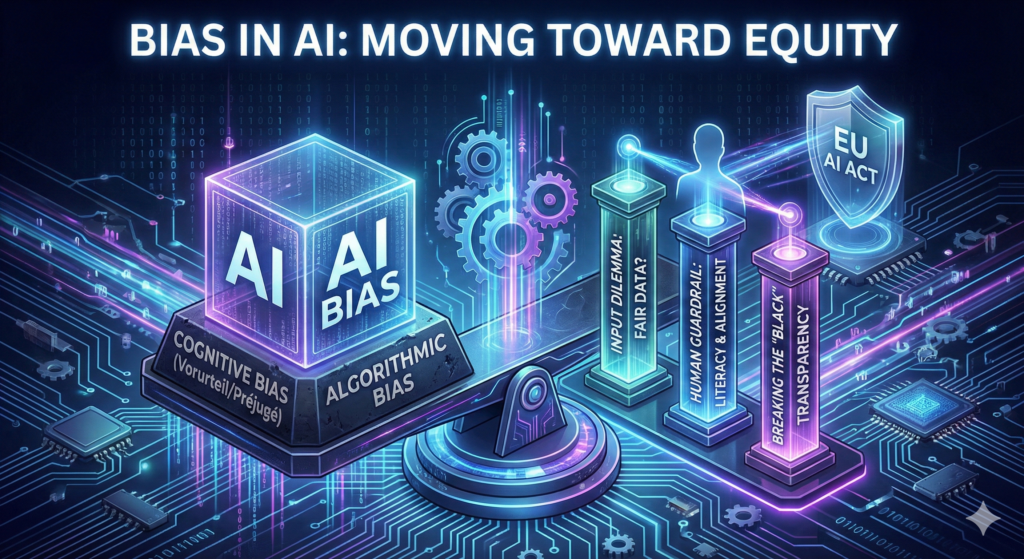
is a disproportionate weight in favour of or against one thing, person, or group compared with another, usually in a way considered to be unfair (Oxford University Press, 2026). In the world of AI, we need to consider specifically Cognitive Bias (The inherent human prejudices) and Algorithmic Bias, where AI systems reflect the prejudices of its creators or the inequities present in the “real world” training data, leading to unfair outcomes for specific groups (IBM 2025).
It’s no longer a secret that bias is baked into both our daily lives and the AI systems we build. As these models gain the power to amplify prejudices and memorize vast amounts of data, controlling these biases has become an uphill battle. To build an equitable digital future, we must address three critical pillars of AI development.
Who decides what is “fair”?
Fixing the machine means fixing what we feed it. We must take much greater care in selecting “fairer” input data. However, this raises complex questions like how do we define “fair” data in a world of conflicting cultural perspectives? Who is responsible for guaranteeing data quality? Should it be private corporations, government regulators, or a new set of international standards (Frontiers, 2025)? Perhaps it is time to ask if we need a “Digital Constitution” to enforce these standards and protect users from systemic data failures.
AI literacy and value alignment
We cannot blame the algorithm if we accept its output without question. Defining the “expected output” is vital if we want to avoid becoming the primary enablers of machine bias. To stay in the driver’s seat, we need to focus on AI Literacy, in order to understand how these systems “think” so we can spot errors (European Commission & OECD, 2025).
Furthermore, it seems vital to leverage frameworks like the EU AI Act to manage high-risk activities through mandatory institutional and human oversight (European Parliament, 2024). However, such oversight is only effective if we achieve “value alignment”, ensuring that functions inside the machines actually reflect the nuanced ethical values of the humans it serves.
Breaking the “Black Box”
For too long, major developers have kept their AI systems as “black boxes,”. As this might be understandable from a business point of view, it does obscure the internal “weighting” of the neural networks, leaving us to wonder how much of the data or the layers of a model contribute to biased results.
Increasing public pressure is probably going to force a move toward a more ethical stance, demanding explainable and transparent AI models, that can be trusted and audited, like the current shift toward Explainable AI (XAI) as a new standard (Valueans, 2026).
Reference list:
IBM (2025), What Is AI Bias? [Online] Available at: https://www.ibm.com/think/topics/ai-bias [Accessed 25 February 2026].
European Parliament (2024), EU AI Act: first regulation on artificial intelligence. [Online] Available at: https://www.europarl.europa.eu/topics/en/article/20230601STO93804/eu-ai-act-first-regulation-on-artificial-intelligence [Accessed 25 February 2026].
European Commission & OECD (2025), Empowering Learners for the Age of AI: An AI Literacy Framework. [Online] Available at: https://ailiteracyframework.org/ [Accessed 25 February 2026].
Frontiers (2025), Reimagining FAIR for an AI World: Advancing FAIR for the AI Era. [Online] Available at: https://www.frontiersin.org/news/2025/03/03/reimagining-fair-for-an-ai-world-frontiers-introduces-fair-data-management [Accessed 25 February 2026].
Oxford University Press (2026). Oxford English Dictionary. [Online] Available at: https://www.oed.com/ [Accessed 25 February 2026].
Valueans (2026), Architecting for Accountability: Why Explainable AI (XAI) is the New Engineering Standard. [Online] Available at: https://valueans.com/blog/tech-transparency-explainable-ai-systems-trust [Accessed 25 February 2026].